


No products in the cart.

Pricing comparisons play a critical role in modern business decision-making. Whether in procurement, logistics, media buying, energy sourcing, cloud services, or raw material acquisition, organizations are often required to choose between contract pricing and spot buys.
Each pricing model operates under different assumptions, risk profiles, and cost structures. As a result, comparing them correctly requires more than simply looking at headline prices.
This article explains how to compare contract pricing and spot buys across financial, operational, strategic, and market-driven dimensions, helping businesses evaluate each option based on real-world conditions.
Contract pricing refers to a pricing arrangement where a buyer and seller agree in advance on pricing terms for a defined period. These agreements typically specify:
Unit pricing
Volume commitments
Contract duration
Escalation clauses
Service levels and penalties
In most industries, contract pricing is used to reduce uncertainty. By locking in rates, organizations can forecast costs more accurately and shield themselves from sudden market fluctuations.
Additionally, contract pricing often includes negotiated discounts. Suppliers may offer favorable rates in exchange for guaranteed volumes or long-term commitments. Over time, these agreements can also evolve into strategic partnerships that extend beyond pricing alone.
Spot buying is the practice of purchasing goods or services at current market prices without a long-term commitment. Prices reflect real-time supply and demand conditions at the moment of purchase.
Spot buys are common in markets with rapid price movement or unpredictable demand. Because there is no ongoing obligation, buyers retain maximum flexibility. However, this flexibility also increases exposure to price volatility.
In favorable market conditions, spot pricing can produce savings. Conversely, during demand spikes or supply shortages, it can quickly become expensive. As a result, spot buying requires active monitoring and faster decision-making.
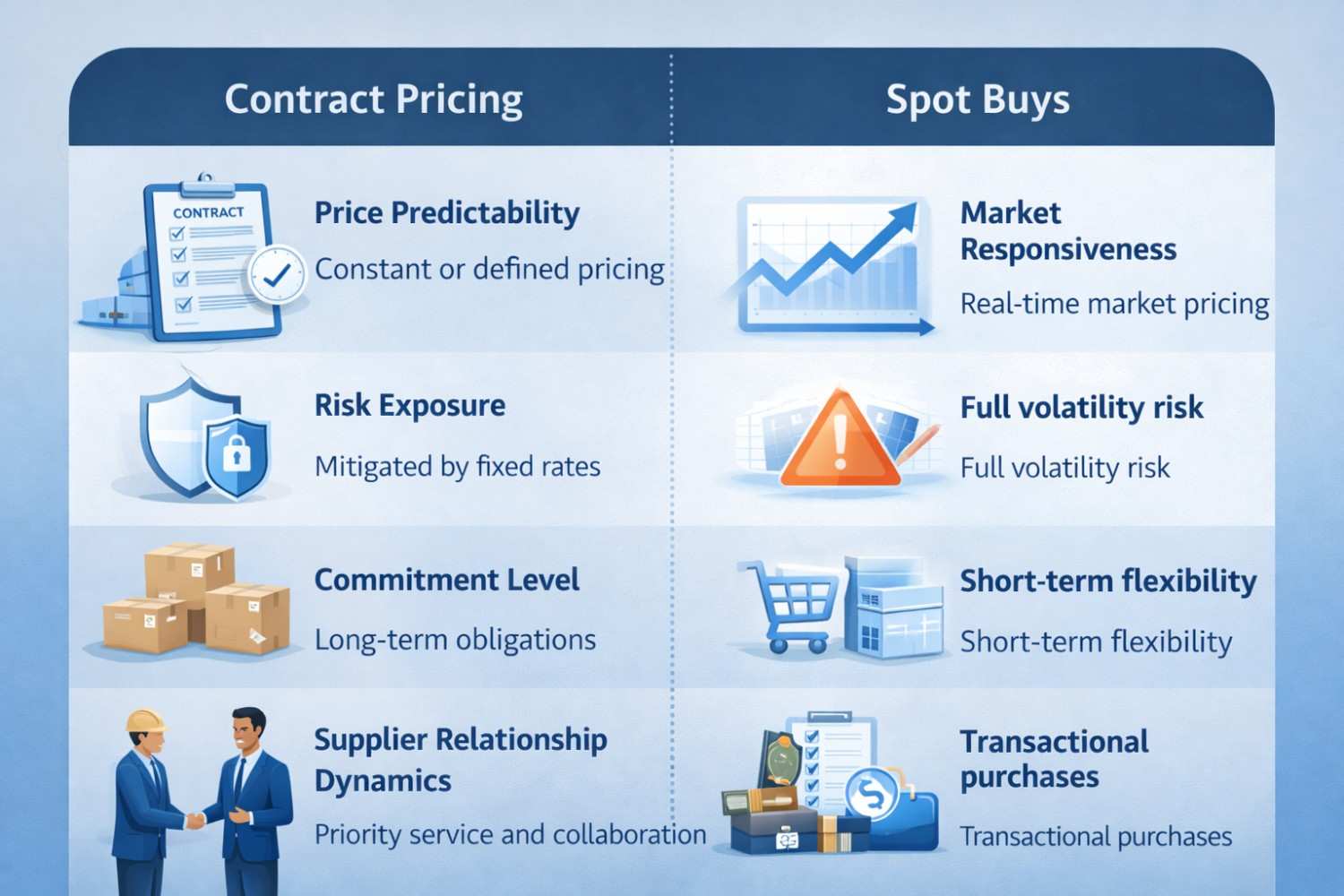
Although both models aim to secure supply and manage cost, they differ in several fundamental ways.
Contract pricing prioritizes predictability. Prices are fixed or adjusted through predefined mechanisms, enabling accurate budget planning.
Spot buys respond directly to market conditions, reflecting real-time pricing dynamics. As a result, contract pricing reduces uncertainty, while spot buying maximizes responsiveness.
Risk distribution varies significantly between the two models.
Contract pricing shifts much of the price risk away from the buyer.
Spot buying exposes the buyer to full market volatility.
While spot buying can deliver savings during price declines, it increases vulnerability during volatile periods.
Contract pricing involves long-term commitments, often including minimum purchase volumes or exclusivity clauses.
Spot buys carry no such obligations, making them better suited for short-term, irregular, or uncertain demand.
In pricing models that rely on long-term contracts, supplier reliability and consistency become just as important as negotiated rates. Eways Traders, a U.S.-based wholesale distributor of medical, healthcare, and personal care supplies, illustrates how working with established distributors can support predictable procurement and pricing stability. By offering access to well-known brands and maintaining consistent product availability, distributors like Eways Traders help buyers reduce supply uncertainty, streamline purchasing decisions, and evaluate contract pricing beyond unit cost alone.
Long-term contracts tend to strengthen supplier relationships. They encourage collaboration, priority service, and operational alignment.
Spot buying is typically transactional, with limited strategic engagement.
Comparing contract pricing and spot buys requires a structured evaluation approach. Focusing solely on per-unit cost often leads to misleading conclusions.
Market behavior is the first factor to assess.
In volatile markets, contract pricing often provides protection.
In stable or declining markets, spot buying may deliver lower average costs.
Historical pricing trends, demand cycles, geopolitical factors, and regulatory changes should all be considered to ensure accurate comparisons.
Demand predictability plays a decisive role.
Consistent, forecastable demand favors contract pricing.
Variable, seasonal, or project-based demand often favors spot buying.
For example, organizations with steady production schedules typically benefit from contracts, while short-term project-driven businesses may prefer spot purchases.
Effective comparisons extend beyond unit price.
Contract pricing often lowers indirect costs such as:
Administrative overhead
Emergency sourcing expenses
Operational disruptions
Spot buys may appear cheaper upfront but can introduce hidden costs related to delays, quality variability, or rushed procurement.
Evaluating total cost of ownership provides a more realistic basis for comparison.
Contract pricing supports predictable cash flow and structured payment schedules, simplifying budgeting and financial planning.
Spot buying introduces variability into cash flow. While manageable for flexible organizations, it can challenge businesses operating under strict financial controls.
In procurement, contract pricing is widely used for raw materials, components, and logistics services to ensure continuity of supply and stable production costs.
Spot buys are typically reserved for exceptions, such as emergency sourcing or short-term market opportunities.
Also, When evaluating pricing models, especially in regulated industries like healthcare, transparency and traceability play a meaningful role in long-term cost control. Understanding how identification standards influence procurement decisions can help buyers assess value beyond price alone. This guide to Unique Device Identification (UDI) for buyers and distributors provides useful insight into how standardized identification supports compliance, inventory accuracy, and supplier accountability—factors that directly impact how contract pricing and spot buys perform in real-world procurement scenarios.
Energy markets clearly illustrate the contrast between the two models.
Contract pricing protects against sudden price spikes and ensures supply security.
Spot pricing enables buyers to benefit from short-term price drops but increases exposure to volatility.
Many organizations adopt blended strategies, securing baseline demand through contracts while sourcing additional volumes on the spot market.
In advertising, contract pricing appears as annual media commitments or guaranteed inventory.
Spot buying dominates programmatic and real-time bidding environments. Brand-focused campaigns often rely on contracts for consistency, while performance-driven campaigns leverage spot pricing for optimization.
In cloud computing, contract pricing includes reserved instances and long-term subscriptions.
Spot pricing allows organizations to purchase excess capacity at reduced rates, but availability is not guaranteed. Comparisons must balance cost savings against reliability and workload criticality.
Contract pricing offers several advantages:
Cost predictability
Reduced exposure to volatility
Guaranteed supply and service levels
Stronger supplier collaboration
Simplified procurement processes
These benefits make contract pricing well-suited for core operations and long-term planning.
Despite its strengths, contract pricing has drawbacks:
Reduced flexibility
Risk of paying above-market rates
Long-term commitment constraints
Penalties for volume deviations
Because of this, contracts should be carefully negotiated and reviewed regularly.
Spot buying provides distinct benefits:
Maximum flexibility
Access to real-time market pricing
No long-term obligations
Ability to capitalize on short-term opportunities
These characteristics make spot buys attractive for variable demand and opportunistic sourcing.
Spot buying also carries risks:
Exposure to sudden price increases
Supply availability uncertainty
Higher procurement effort
Limited supplier loyalty
Overreliance on spot buys can increase operational and financial risk.
Many organizations adopt hybrid pricing strategies, combining both models.
In this approach:
Contract pricing covers baseline demand
Spot buys address fluctuations or excess requirements
This balance stabilizes costs while preserving flexibility, particularly in volatile markets.
Pricing strategies are influenced by geography.
In regions with limited suppliers or unstable infrastructure, contract pricing enhances supply security.
In competitive markets with abundant suppliers, spot pricing may provide stronger leverage.
Local regulations, transportation costs, and regional demand patterns must be considered in all pricing evaluations.
Modern pricing decisions increasingly rely on analytics and forecasting tools.
Machine learning models can:
Analyze historical trends
Predict price movements
Simulate sourcing scenarios
From this perspective, contract pricing and spot buys represent different risk-management frameworks rather than simple purchasing choices.
Is contract pricing always safer than spot buying?
Contract pricing reduces volatility risk but may increase cost risk if market prices decline.
Can spot buying be cheaper over time?
Yes, especially in stable or declining markets, but outcomes depend on timing and discipline.
Should businesses rely on only one model?
In most cases, combining both models produces better results.
To compare contract pricing and spot buys effectively, organizations should assess:
Market volatility
Demand stability
Risk tolerance
Financial flexibility
Strategic importance of supply
Each factor influences which model performs better in a given context.
Comparing contract pricing and spot buys requires a comprehensive understanding of cost structures, risk exposure, and market dynamics.
Contract pricing delivers stability, predictability, and supply assurance. Spot buying offers flexibility and access to real-time pricing opportunities. Rather than treating them as competing options, businesses achieve stronger outcomes by understanding when and how to use each model.
By aligning pricing strategies with market conditions, operational needs, and financial objectives, organizations can make informed decisions that support long-term performance and resilience.


Leave a comment