


No products in the cart.

In the global medical device ecosystem, accurate identification of products is essential for safety, compliance, and operational efficiency. As healthcare supply chains become more complex and increasingly regulated, one system has emerged as a universal foundation for traceability: UDI, or Unique Device Identification.
For buyers and distributors, UDI is not just a regulatory label placed on a box. Instead, it is a data-driven identification framework that directly influences purchasing decisions, inventory control, recall handling, regulatory compliance, and supply chain transparency.
Understanding UDI is therefore critical for anyone involved in sourcing, distributing, or managing medical devices. This guide explains UDI in clear, practical terms, with a focus on how it impacts buyers and distributors across different markets.
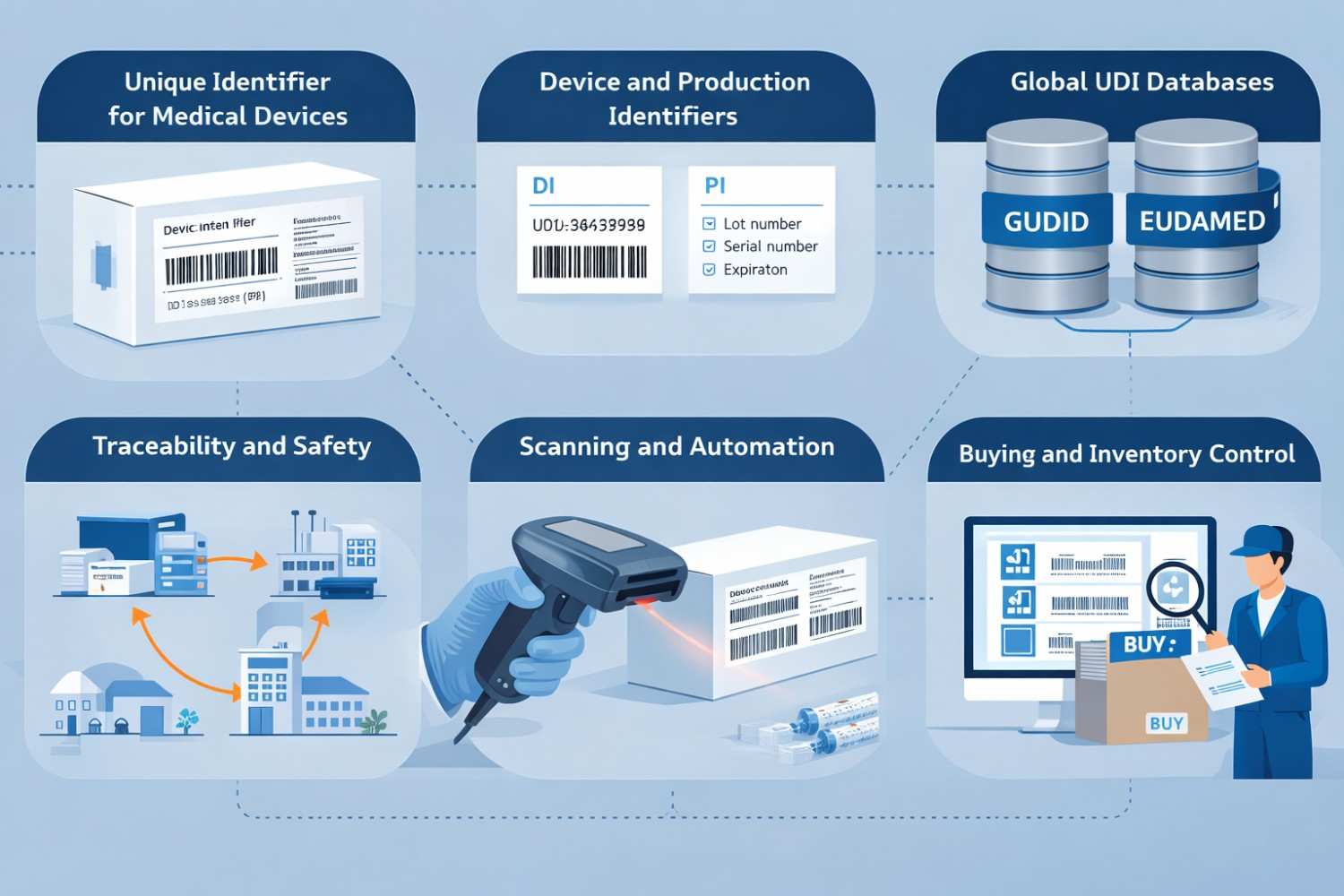
UDI (Unique Device Identification) is a standardized system used to uniquely identify medical devices throughout their lifecycle—from manufacturing and distribution to use and post-market monitoring.
Rather than relying on product names, internal SKU numbers, or inconsistent labeling practices, UDI assigns a globally recognized identifier to each medical device. This identifier allows devices to be tracked accurately across organizations, systems, and borders.
As a result, UDI creates a shared language for medical device identification across manufacturers, distributors, healthcare providers, and regulators.
Before UDI existed, identifying medical devices across the supply chain was often inefficient and error-prone. Devices were described differently by manufacturers, distributors, and hospitals, leading to confusion, delays, and safety risks.
Because of these challenges, regulatory authorities introduced UDI to address several critical issues:
Difficulty tracing devices during recalls
Limited visibility into device distribution
Inconsistent product identification across systems
Increased risk of counterfeit or misidentified devices
By standardizing device identification, UDI improves traceability, accelerates recall actions, and enhances overall patient safety.
Although manufacturers are responsible for assigning UDI codes, buyers and distributors are directly impacted by how UDI is used and managed.
UDI affects:
Medical device manufacturers
Wholesale distributors
Group purchasing organizations (GPOs)
Hospitals and healthcare systems
Government and regulatory bodies
Therefore, even organizations that do not create UDI labels must still understand, capture, and manage UDI data correctly.
Every UDI consists of two distinct components. Each part serves a specific purpose and provides different types of information.
The Device Identifier (DI) is the permanent part of a UDI that identifies the manufacturer and the specific device model. It includes:
Manufacturer identification
Device model or version
The DI remains constant for all units of the same device configuration.
For buyers and distributors, the DI supports:
Product verification
Catalog and master data management
Regulatory documentation
Product and price comparisons
The Production Identifier (PI) is the variable part of a UDI that contains production-related information. This may include:
Lot or batch number
Serial number
Manufacturing date
Expiration date
Because of this, the PI is critical for recall management, inventory rotation, and quality control.
UDI information is typically presented in two formats:
Human-readable text, visible on the label
Machine-readable code, such as a barcode or DataMatrix
This dual-format approach allows UDI to be used both manually and through automated scanning systems.
For distributors, machine-readable UDI improves warehouse efficiency. For buyers, it simplifies receiving, verification, and documentation processes.
UDI does not function in isolation. It is supported by centralized regulatory databases that store device information linked to each identifier.
In the United States, UDI data is submitted to the Global Unique Device Identification Database (GUDID), maintained by the FDA.
GUDID includes information such as:
Manufacturer name
Device classification
Intended use
Labeling details
Buyers and distributors often reference GUDID to confirm product legitimacy and regulatory status.
In the European Union, UDI information is stored in EUDAMED, the European database for medical devices.
EUDAMED supports transparency across EU member states and plays a key role under the Medical Device Regulation (MDR). For organizations operating internationally, understanding both databases is essential.
Although UDI originates at the manufacturing level, buyers benefit directly from its implementation.
UDI allows buyers to confirm exactly which device is being purchased, reducing errors caused by similar product names or outdated listings.
Standardized identifiers make it easier to compare equivalent products across suppliers using objective data.
UDI enables buyers to isolate affected inventory quickly, minimizing disruption and waste.
When integrated into procurement systems, UDI reduces manual entry errors and ensures consistent records.
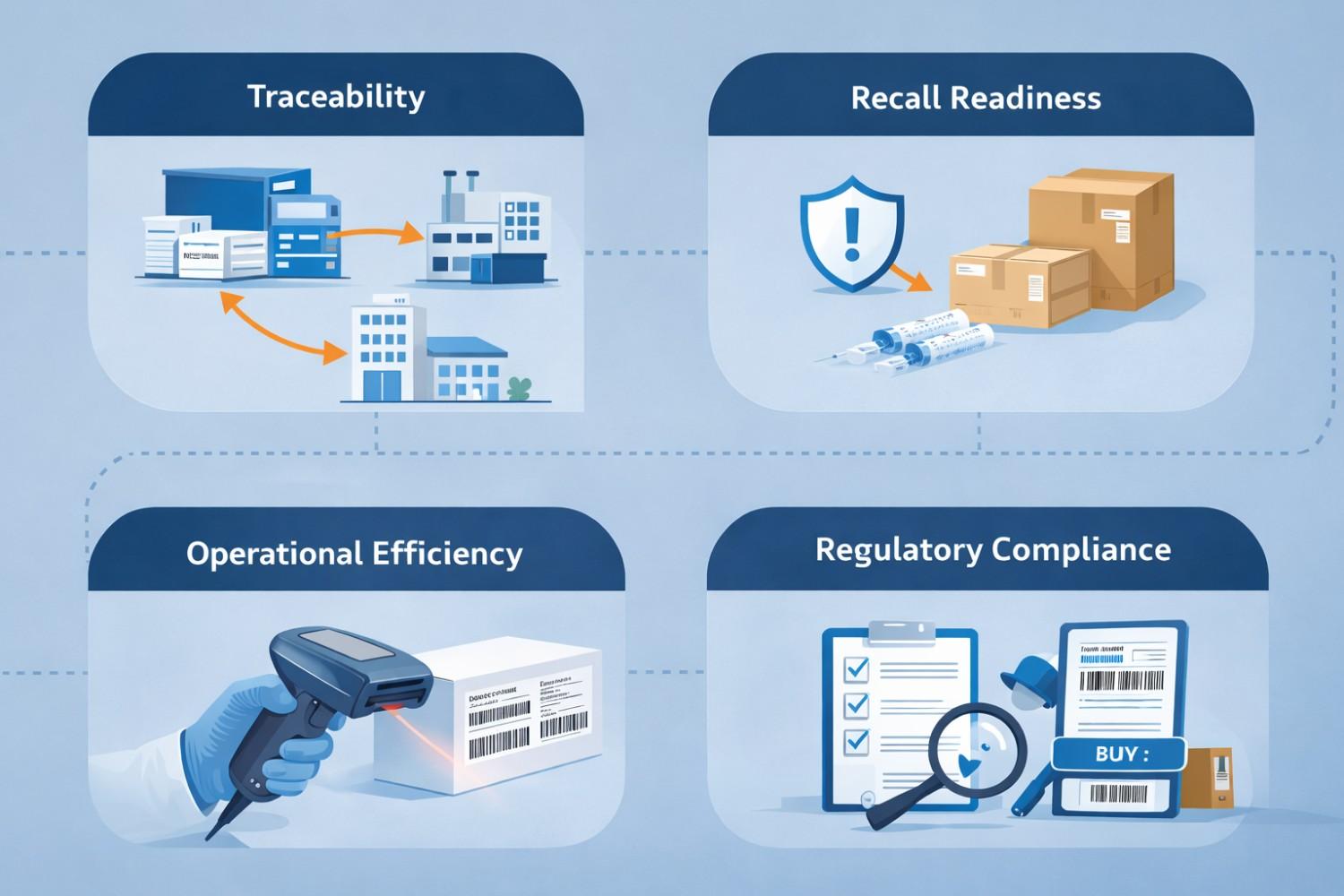
For wholesale distributors, proper UDI handling is closely tied to credibility and supply chain reliability. Eways Traders, a U.S.-based wholesale distributor headquartered in Kent, Washington, exemplifies how distributors can support UDI-driven transparency by sourcing and supplying clearly identified medical, healthcare, and personal care products. Partnering with well-known brands like Seni, Tranquility, Dynarex, and TZMO USA Inc., Eways Traders helps ensure consistent access to genuine medical and personal care products that align with current traceability practices and compliance expectations. This level of accountability helps downstream buyers manage inventory more accurately and respond confidently to regulatory and quality requirements.
UDI supports accurate tracking of devices from receipt to shipment.
Distributors can quickly identify and quarantine affected inventory during recalls.
Scanning UDI codes speeds up receiving, picking, and shipping processes.
Maintaining accurate UDI records simplifies audits and inspections.
UDI enables item-level or batch-level inventory tracking. With proper integration, organizations can:
Monitor expiration dates automatically
Improve first-expired, first-out (FEFO) practices
Reduce waste from expired products
Improve demand forecasting
These benefits directly support cost control and patient safety.
UDI is becoming a core data element in digital healthcare environments.
When integrated into systems such as:
ERP platforms
Warehouse management systems (WMS)
Electronic health records (EHRs)
organizations gain access to more accurate analytics, reporting, and purchasing insights.
Understanding key UDI terms improves communication and reduces errors.
Issuing Agency: Authorized organizations that issue UDI codes (e.g., GS1)
Basic UDI-DI: A higher-level identifier used in the EU to group related devices
Direct Marking: Permanent UDI marking on reusable devices
Although UDI requirements vary by region, many countries are aligning with international standards. This harmonization reduces complexity and improves consistency for global buyers and distributors.
Despite its advantages, UDI implementation presents challenges.
Incomplete or incorrect UDI data reduces effectiveness.
Legacy systems may require updates to support UDI.
Staff must understand how to scan, record, and use UDI data correctly.
Buyers can maximize UDI value by:
Requesting UDI data during procurement
Verifying identifiers against regulatory databases
Using UDI in recall and inventory workflows
Standardizing UDI usage across departments
Distributors should focus on:
Capturing UDI at every transaction point
Maintaining clean, consistent UDI records
Sharing UDI data with downstream partners
Using UDI to support audits and traceability
What does UDI stand for?
Unique Device Identification.
Is UDI mandatory?
Yes, for most medical devices in regulated markets.
Who assigns the UDI?
The manufacturer, using an authorized issuing agency.
Do distributors label products with UDI?
No, but they must capture and manage UDI data accurately.
UDI implementation varies by region. International organizations must account for:
Different regulatory timelines
Database requirements
Reporting obligations
Adapting processes by geography ensures compliance and continuity.
As healthcare becomes more data-driven, UDI will continue to evolve. Emerging technologies such as automation, artificial intelligence, and advanced analytics will further increase its value.
For buyers and distributors, UDI will increasingly support:
Predictive inventory planning
Advanced recall analytics
Greater supply chain transparency
UDI is a foundational system for modern medical device supply chains. For buyers, it improves product verification, purchasing accuracy, and recall readiness. For distributors, it enhances traceability, operational efficiency, and regulatory compliance.
Although UDI began as a regulatory requirement, it has become a powerful tool for data accuracy and supply chain visibility. In an increasingly complex global market, UDI is not just an identifier—it is a critical enabler of trust, transparency, and efficiency across the medical device ecosystem.


Leave a comment